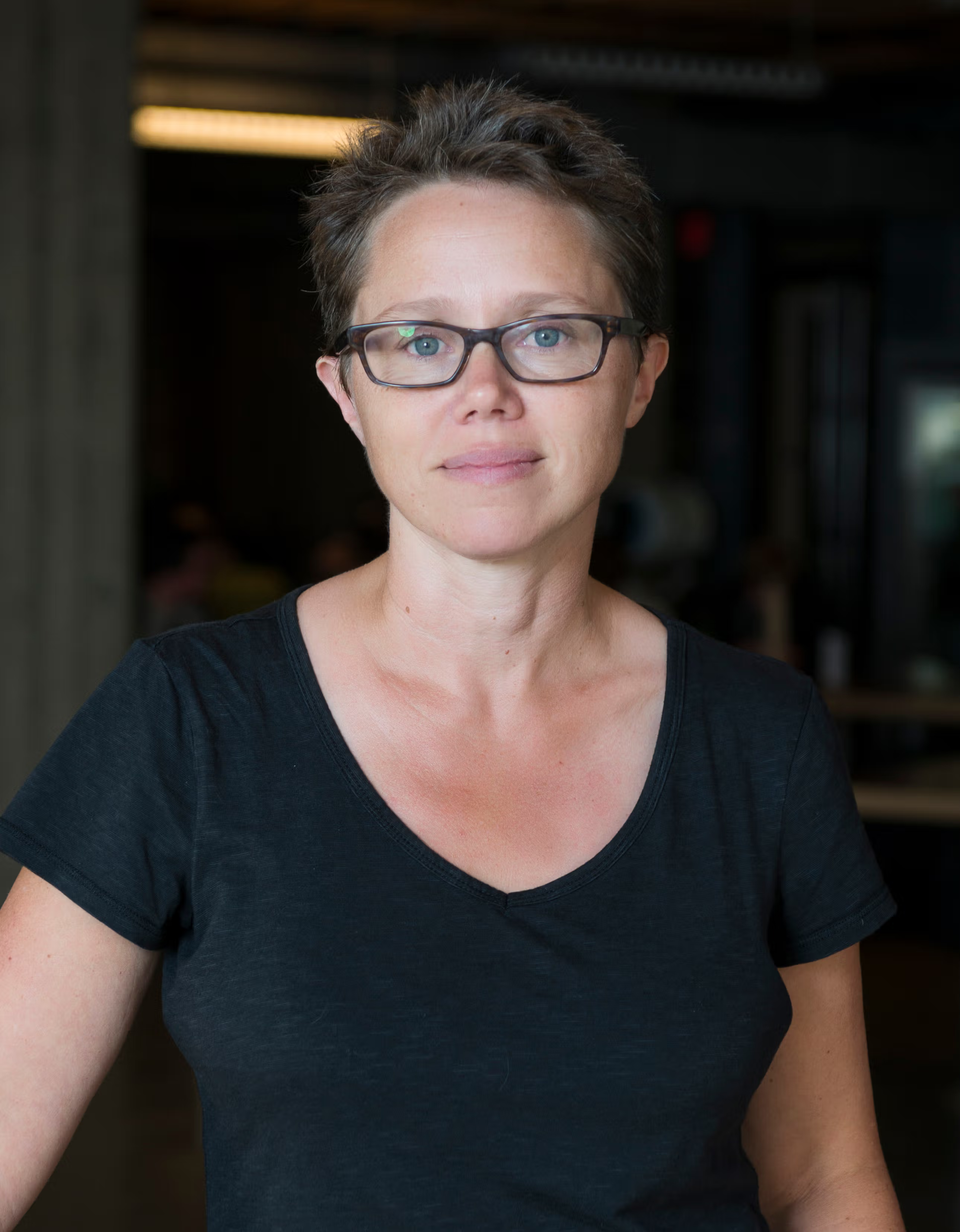
Who Is Rachel Chalmers?
Rachel Chalmers calls herself a failed English professor. She was in graduate school in Ireland during the 1994 World Cup, got bored at a friend's house during the match (she is, in her words, "the only Australian who can't even pretend to be interested in sport"), and picked up a lime-green and orange magazine someone had left on the floor. It was her first copy of Wired. By the time the final whistle blew, she had decided to drop English, move to San Francisco, and write about computers. She did.
Rachel is a Co-Founder and Co-General Partner at Generationship, a venture fund she started with Michelle E that closed its inaugural $2.7M fund oversubscribed in 2026. Before that, she was one of the founding employees at 451 Research, where she covered more than a thousand venture-backed companies. That decade and change of analyst work was, in her telling, basic training for being an investor: "pattern recognition at large scale."
What makes Rachel worth an hour is not the resume. It is that she talks about markets the way a naturalist talks about ecosystems. She is a horse person. She reads Darwin cover to cover. She lives in a nineteen-nineties view of what the internet was supposed to be for, has watched that view get beaten up by thirty years of reality, and still invests like someone who believes the future is improvable one well-engineered thing at a time.
The Archetype: The Sage
The Sage
The Rebel
Tests & Allies
Rachel's primary archetype is The Sage. Her secondary archetype is The Rebel. Everything she does professionally runs through understanding first: 1,000 companies covered, 15 years of McKinsey and First Round data memorized, a thesis built not from a hunch but from a stack of research she can rattle off from memory. When she describes finding Generationship's thesis, the metaphor is almost scientific: collect rejections, map the negative space, keep whittling until only the thing you absolutely know remains.
You can hear the Sage in how she explains almost anything. Asked about the mechanism of underpricing in venture, she does not reach for a story. She builds a model: venture is a series of gates, each gate is a de-risking event, each gate is supposed to bring in a new lead investor to reprice against the market, and the alpha lives in the gap between what the earliest investors think the risk is and what the next-stage investors eventually prove it to be. Only after the model is standing does she bring in the Adira case to illustrate it. Build the framework first, then light it up with the example.
The Rebel sits behind the Sage and does the real work. Rachel is not a diversity investor; she is a mispricing investor who thinks the industry has been systematically wrong, in a specific and measurable way, for fifteen years. "We are not a charity. We are a financial fund," she says, with the kind of flatness you only get from someone who has had to clarify this many times. The rebellion is in refusing both the woke framing and the consensus framing. Her position is that the market is leaving money on the table because it keeps investing in younger versions of itself, and she is going to collect that money.
"Technical women are underpriced at pre-seed. We're so absolutely convinced of that, we have a huge stack of research, and it proves itself every day."
The Hero Match
Charles Darwin
Rachel spent the last five minutes of this interview talking about reading On the Origin of Species in its entirety for the first time at fifty-four. The description was personal enough that it reads less like a book recommendation and more like a self-portrait she had not noticed she was drawing. Darwin, in her telling, spent the first half of his life exploring and collecting and surveying the space, then moved to Down House and spent the next forty years thinking about his collections and corresponding with naturalists and fancy-pigeon-breeders around the world. "That's super relatable, because I've done the same thing," she says.
The parallel runs deeper than career shape. Darwin's quiet thesis is that variation inside a species, given enough time, becomes the engine that produces new species. He was arguing, against the dominant frame of his era, that the interesting action was in the margins, not the center. Rachel's investment thesis is almost structurally identical. The interesting founders are the variations the industry has not learned to price. Given a little capital and a little time, the variation performs. She even uses Darwin's own correction to defend her view: "survival of the fittest" is not about gladiators, it is about fitness for purpose, about how organisms fit into an ecosystem. That is the sentence a venture capitalist says when she is tired of being asked to compare her portfolio founders to Stanford dropouts.
Darwin also kept writing after losing his favorite daughter at five years old, and found his comfort not in a creator god but in the multiplicity and beauty of the world as it actually was. Rachel's politics are a secular version of the same move. She is terrified about climate and geopolitics ("I live in the real world. I'm terrified all the time. I'm a sentient human. I have children.") and she keeps investing in incremental improvements anyway, because the alternative is to stop looking at the world.
Beth Harmon, The Queen's Gambit (2020)
For a modern parallel, Rachel is Beth Harmon. Not the troubled-prodigy Beth of the opening episodes, but the mid-series Beth who has figured out that her advantage is the quality of her pattern recognition and the courage to trust it against better-resourced opponents. Beth beats richer, older, better-mentored chess players because she sees the position differently and has done more reps looking at boards. Rachel beats bigger, more capitalized funds because she has looked at a thousand companies and has a technical partner who was lead engineer on IBM Watson at sixteen. The resource gap is the point. The pattern-matching is the edge.
Beth is also a woman winning in a world designed for men without ever pretending that is not what she is doing. Rachel's version of this is more wry and less lonely, but structurally the same. She chose infrastructure software because it was "hard and boring and not glamorous" and therefore harder to fire her from. She survived in tech by making herself expensive to replace. Then she turned that same discipline into an investment thesis.
"We came from really anomalous backgrounds, and that lets us see potential in other founders that come from really anomalous backgrounds. And I do think that's where the real returns come from."
The Story Behind Generationship
There is a moment Rachel keeps returning to that is not framed as the origin story, but behaves like one. She is sitting outside in the garden with her laptop on her lap, about to get on a call with Mark Templeton, the former CEO of Citrix and DigitalOcean. She has known Mark for years. He is a mentor and a friend. He is also, she knows, not going to invest in Generationship out of affection. He will invest if and only if the thesis is real.
She pitches him. He says, "Yeah. I'm in." That is the moment, she says, when she knew the fund was going to work. Not because he was the biggest check (there would be bigger), but because he could see what she saw based on his own experience. Her story was now good enough to be portable to someone who had earned the right to disagree.
Before that, Generationship had been a different company. Rachel and Michelle had originally imagined something closer to a consulting-firm accelerator for all underrepresented founders. A mentor took them aside and told them to narrow it down, then narrow it further, then narrow it again. What they ended up with was almost unfashionably specific: technical women are underpriced at pre-seed, Generationship invests in them, they outperform, Generationship makes money. That is the whole pitch. It is a sentence a middle-schooler could follow and a sentence an institutional LP can underwrite.
The thesis has already produced two markups in two years of deployment. The fund wrote an early check into Adira, a container-virtualization play built on the old Zen paravirtualization method brought up to date in Rust, and Microsoft's strategic venture arm M12 marked it up 4x within three months. The fund also backed Coval, Brooke Hopkins's YC-born voice-agent eval company, after Rachel recognized that the test harness Brooke had built for Waymo would be exactly what the voice-agent market needed. The most recent investment is Quint, Gabriella's formal-verification startup, which Rachel's husband Jeremy (the Rust guy at Meta) vetted on a phone call and came back with two thumbs up.
The Founder's Journey ↔ The Fund's Journey
English graduate student in Ireland reading a Wired magazine someone left on the floor, moved to San Francisco to write about computers, became one of the founding employees at 451 Research covering 1,000+ companies, spent 12 years as an investor including a run at Alchemist Accelerator, closed Generationship Fund I oversubscribed in 2026, now deploying capital and planning Fund II.
An all-underrepresented accelerator idea, narrowed under mentor pressure to "technical women at pre-seed are mispriced," raised against a wall of rejections, closed oversubscribed at $2.7M, deployed into Adira, Coval, Quint and a growing portfolio where roughly 75% of companies have male co-founders and the most successful teams so far are all women.
The same Sage archetype runs through both. The founder spent 20 years staring at infrastructure companies until the pattern was obvious. The fund spent six months staring at its own thesis until only the irreducible claim was left. Both arcs are about looking until what is really there becomes visible.
Founder Superpowers
Spotting the mispriced category, not the mispriced company
Rachel does not just hunt for undervalued deals. She hunts for undervalued categories of founder. The move at 451 Research was to cover a thousand companies and extract the latent pattern. The move at Generationship is to notice that 15 years of McKinsey and First Round data say women-led companies outperform by about 43% while 2% of venture capital goes to them, and to treat that gap as a durable, systemic mispricing rather than a political talking point. "That disconnect is our opportunity."
Technical pattern-matching across a career of infrastructure deals
Rachel's taste in infrastructure is specific and earned. She saw Xen, VMware, and Docker reinvent deployment, so when Adira's founders proposed bringing old Xen paravirtualization into the Rust era for Kubernetes and LLMs, she recognized the shape of the thing before most investors could follow the sentence. She watched Christine Yen and Charity Majors build observability out of a Facebook internal tool called Scuba, so she already understood why open-ended infrastructure questions beat threshold-based metrics. The gift is not that she bets on infrastructure; it is that she bets on infrastructure founders two cycles ahead of the market because she has already lived the pattern they are rhyming with.
Compressing a thesis to one unignorable sentence
Rachel can describe her entire fund in twelve words: "We invest in overlooked technical women founders. They outperform the market and we make money." That is the sentence that unlocked Mark Templeton, that closed the fund oversubscribed, and that keeps the thesis sharp enough to say no with. The Sage superpower here is not writing a longer memo. It is editing a thesis down to the sentence that cannot be argued with, then being willing to defend it against hundreds of people who will tell her she is wrong.
What It's Like to Be Backed by Rachel
Rachel is high-engagement without being loud. She explains before she pitches. She reaches for a framework before she reaches for a story, then reaches for a story to make the framework stick. The result, in a founder meeting, is that you leave with a model of why she thinks what she thinks, not just a yes or a no. That tends to be useful even when the answer is no, because the model travels.
She is also disarmingly happy to be wrong in public. She closed the fund by collecting rejections. She tells her founders to go collect a hundred of their own. She describes her own career as a series of fortunate anomalies ("way out on the very narrow end of the normal curve in terms of luck and circumstance") and she credits specific people by specific names: Edith Harbor at LaunchDarkly, Sherry Way at Aviatrix, Christine Yen and Charity Majors at Honeycomb, Brooke Hopkins at Coval, Emily Long at Adira, Gabriella at Quint, Michelle E as her partner, Jeremy as the formal-verification sanity check. The credit is not performative; it is how she makes decisions. When Jeremy walked out of a technical diligence call with two thumbs up, that was the yes.
The investment style is early, convicted, and infrastructure-biased, with a stated preference for founders who can articulate a contrarian view of how the world could be better and defend it passionately. If you walk in with a vague vision and a growth deck, you are not her founder. If you walk in with a hard-won read on where a specific layer of the stack is broken, and the technical depth to argue it against a skeptical room, you are talking to one of the few investors in the market who will enjoy the argument.
"Find that weirdness. Find the thing that is completely unique about you. Because all of the grinding stuff, LLMs can do that now. Work for humans is caring about stuff."
The core tension: Pattern vs. Anomaly. Rachel's entire edge is pattern recognition at 1,000-company scale, and her entire thesis is that the money is in the founders who do not fit the pattern. She resolves it by using pattern to find anomaly: she knows the shape of what the market mis-sees, so she can price the exceptions before anyone else does.
Why This Matters (For You)
If You're a Technical Woman Founder Raising a First Round
Rachel's pitch to you is almost brutally practical. She is going to assume you are brilliant and competent, because the data says you probably are. She is also going to assume that most of the market is still, in 2026, allocating capital like it is 2015. Her best fundraising advice is to go collect a hundred rejections on purpose, because rejections are data and the only way to find the irreducible sentence that is your actual thesis is to delete everything that is easily dissuadable. "Narrow it down. Narrow it down. What's the core of it?" If you can articulate a contrarian view of how a specific layer of the world could be better, defend it technically, and show the first signal of demand, there is now at least one fund in the market that will not treat you as an exception to be explained.
If You're an Allocator or Angel Thinking About Where Venture Is Going
Rachel's read on the industry is not primarily about gender. It is about market structure. The biggest funds have, in her view, drifted into a kind of index behavior: write large checks into obviously good deals, mark up your own book, generate fees. That strategy is defensible for the funds running it. It is also, by her read, no longer venture. If you believe her, the alpha has moved to the parts of the market those funds no longer serve: pre-seed, non-elite geography, non-elite pedigree, non-consensus theses. The question for any allocator in 2026 is whether to keep paying consensus prices for consensus founders, or to back the funds that are willing to do the harder work of pattern-matching on the overlooked.
If You're Early in Your Career and Watching the Ladder Disappear
Rachel went through her own version of this in the 1990s, when she realized tenure in English departments was not going to be a career. Her answer then is her answer now: find the thing that makes you weird, bet on it, and make yourself expensive to replace. She chose infrastructure because it was "hard and boring" and therefore defensible. She tells her founders the same thing she tells her kids: the repetitive, boring work is going to computers, and the durable advantage is caring, lateral thinking, and the capacity to have novel thoughts. The advice is not comforting. It is, however, the same advice she acted on, and the career she built is the proof the strategy still works.
If You're an Engineer Deciding Where to Build
Rachel's taste tilts toward infrastructure for a reason she states plainly: it is highly leveraged. One good observability tool changes how thousands of teams run their post-mortems. One good feature-flagging layer changes how safely large systems can ship. If you are an engineer trying to decide where to spend the next five years of your life, her implicit argument is that the layers of the stack where a small, correct bet can quietly change how many other people work are the layers worth caring about. "Software is archaeology. We build cities on top of cities on top of cities." Pick a layer that the next city is going to need.