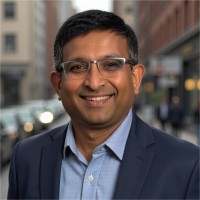
Who Is Murali Swaminathan?
Murali Swaminathan is the Chief Technology Officer of Freshworks, the publicly traded company (NASDAQ: FRSH) rebuilding a fifteen-year-old customer- and employee-service platform for the age of AI agents. He came to the role from ServiceNow, and to the industry from a career that stretches back before the internet — through client-server, through the rise of SaaS, and now into agentic AI.
What makes him worth an hour of your time isn't the title. It's the perspective. Murali is one of the few technologists steering an AI transformation who has personally lived through three earlier ones, and he brings that memory to bear on every prediction. He'll tell you more than 70% of Freshworks' new code is now written by AI — and in the same breath tell you why that means engineers spend more time reviewing and designing, not less.
He is, in the oldest sense of the word, a teacher. Ask him a hard technical question and the answer comes back as an image you can hold: a Ferrari that shouldn't be driven to the grocery store, a handyman reaching into a toolbox, a plasma TV becoming an LED one. Underneath the analogies is a systems mind that has thought carefully about how powerful tools should — and shouldn't — be handed to people.
The Archetype: The Sage
The Sage
The Explorer
The Return
Murali is a Sage: driven by understanding, compelled to explain, most alive when he's making a complicated thing simple. He doesn't reach for the newest buzzword; he reaches for the pattern underneath it. When asked what thirty years across four technology waves taught him, he didn't name a product or a number — he named a posture: "It is just the curiosity to learn."
His secondary archetype is The Explorer — the restless drive to try the next thing and to never trust a single tool. "Don't trust one system," he said. "Evaluate with different models and judges." He experiments constantly and treats each technology wave as terrain to be mapped rather than a trend to be chased.
"You can't use a Ferrari to go to the grocery shop. You have to use the right tool for the right purpose."
The Hero Match
Daedalus
In Greek myth, Daedalus is the master craftsman — the engineer who builds the labyrinth and fashions the wings, the mind behind the marvels rather than the king who commands them. That distinction matters here: Murali is the technologist behind the product, not a figure on an org chart, and the myth honors exactly that kind of builder.
But the parallel gets sharper at the wings. Daedalus gives his son the power of flight and, in the same moment, warns him not to fly too close to the sun. That is precisely Murali's stance toward AI. He will build the most capable agentic system he can — and insist, without pause, on its limits. "Be the human in the loop," he says. "Don't blindly trust its output." And then the line that could have come straight from Daedalus handing over the wings: "Assume this is the worst AI you'll ever use." Build the power; name the danger; do both at once.
Lucius Fox — The Dark Knight trilogy
The version people will recognize instantly is Lucius Fox — the brilliant engineer who builds Batman's most powerful technology and is also the one who draws the ethical line when the power gets too great. Murali is that character for the AI era: he'll ship the agent studio and let agents take real actions, then say plainly, "We don't want any rogue AI agents. You don't want an agent which has superpowers and does anything it wants." Quietly indispensable, never the frontman, always the one who makes the powerful thing safe to use.
"We don't want any rogue AI agents… you want agents that are limited by the powers of what they can do."
The Story Behind Freshworks
Late in the conversation, Murali did something most executives at public companies avoid. Asked whether it was really true that more than half of Freshworks' code is now written by AI, he didn't retreat into a talking point. He got more precise: not 100%, more than 50% overall, and for anything new, more than 70%. Then he told the honest, unglamorous consequence of it — engineers who used to write a thousand lines a day are now shipping ten thousand, so the bottleneck moved from writing to reviewing. His fix wasn't a slogan; it was a rule: don't commit more than 500 lines at a time, because "anything more than 500 lines is hard for somebody to read."
That's the whole man in one answer. A powerful new capability, adopted fast — and a small, concrete brake installed the moment it's adopted. He'll tell you Freshworks' AI agents resolve tickets at "high 70s" accuracy today, up from 40%, and that the bar is 90% and they're not there yet. He'll predict that AI agents will soon outnumber employees — and immediately add that every one of them needs an identity, an audit trail, and an off switch. The optimism and the caution are never separated.
The Founder's Journey ↔ The Company's Journey
From the pre-internet era, through the client-server and SaaS waves he watched take a decade to mature, to arriving at Freshworks as the technologist charged with rebuilding a fifteen-year-old platform for AI — now in the phase where he translates all of it into guidance for the engineers, teams, and next generation coming up behind him.
From a chatbot-and-workflow service platform, to LLM-assisted products, to a full agentic system where AI takes real action across IT, HR, and customer service — a fifteen-year-old company being rebuilt in public, "while the plane is still flying."
The same Sage drives both. Freshworks' evolution — chatbot to LLM to agent, always with a governance layer bolted on — is Murali's own worldview made into a product: adopt the new power, but never without the guardrail. The company is the man's disciplined curiosity, shipped.
How Murali Leads
Murali leads by consensus and by staying in the work. When he narrates decisions, they're team discoveries — "we've come up with best practices," the data scientists "constantly looking at model evaluations," rewards tied to outcomes the group agrees actually shipped. He is openly skeptical of leaders who stop building: "Managers cannot be just pure people managers. They need to roll up their sleeves and support the team." Even as CTO, he still runs his own agents and queries systems directly through their interfaces rather than through dashboards.
He's also unusually honest about difficulty for someone in his seat. "We're making all those mistakes, and we're finding those mistakes are expensive, and we're fixing them along the way." No spin, no defensiveness — just a steady account of where things actually stand.
Founder Superpowers
Teaching complexity through the everyday
He compresses hard technical tradeoffs into images anyone can hold. Model selection becomes "you can't use a Ferrari to go to the grocery shop." Agentic tool-use becomes "a handyman with a toolbox… we're empowering the handyman to figure out which tool to use." It's not a communication trick — it's how he makes better decisions accessible to everyone around him.
Reading the adoption curve across eras
Having lived through pre-internet, client-server, and SaaS, he pattern-matches the shape of the AI wave rather than guessing at it. "SaaS took ten-plus years to settle… AI will be faster, but the guardrails will take time — and that only happens through mistakes." The historical lens produces calm, specific predictions.
Shipping fast while installing the brakes
He pairs aggressive adoption with concrete governance in a single breath: more than 70% AI-written code alongside a 500-line commit ceiling and AI-plus-human review; autonomous agents alongside a vetting process for outbound integrations, confidence thresholds, and a human in the loop below 50% confidence.
What It's Like to Work with Murali
By the evidence of an hour-long unscripted conversation: measured, curious, and generous with what he knows. He thinks before he speaks, and when he does, he teaches — you leave understanding the thing, not just having heard about it. He defaults to "we," credits his data scientists and engineers by function, and describes a team culture that is deliberately fluid: "You can form your own teams with like-minded people," people "pull tasks and get them done" rather than waiting on rigid sprints, and curiosity is the trait he watches for. "Whoever is willing to embrace change — they are the ones actually succeeding."
He also protects space for exploration without turning it into a mandate. No forced "20% time"; instead, hackathons, experimentation tracks, and room between projects for people to build tools that help everyone. It's a culture that rewards people who ship and people who tinker — and expects managers to do both.
"The curious learners will always do it wherever you are. Good thing about AI is it's opening the doors for many people."
Why This Matters (For You)
If You're an IT or Customer-Service Leader Evaluating AI Agents
Murali's whole architecture is a lesson in governed autonomy. He won't let a customer turn on just any outbound integration — there's a registration and vetting process, role-based access checks behind every read and write, and a hard human-in-the-loop threshold when confidence drops below 50%. If you're deploying agents into IT, HR, or support, the question he'd have you ask isn't "how autonomous can this be?" but "what's the audit trail, and where's the off switch?" His bar — 90% resolution accuracy, and honesty that they're at "high 70s" — is a healthier benchmark than the demos you've been shown.
If You're an Engineer Building Agentic Systems
Watch how he decides what runs on a frontier model versus a traditional one. Not everything belongs in an LLM — ticket field prediction still runs on classical ML because "you can't push millions of records into an LLM," while summarization goes to a frontier model. His team evaluates each use case against accuracy, record-count tipping points, and token cost before choosing. And study the MCP distinction: inbound servers they built and secure themselves; outbound servers they vet before exposing. The takeaway for your own work: the hard part isn't generating code, it's designing which tool solves which problem — "coding is the easier part."
If You're Early in Your Career
His arc is a case for range over specialization. "You don't need as many specialists," he said — the people thriving are the ones who can move across roles, "the developer, the designer, the tester, the security person" in one. But notice the counterweight: he told his own son that hands-on, electro-mechanical skill has more durability because "certain things cannot be replaced with AI." The lesson isn't "learn to prompt." It's: cultivate the judgment to know which tool fits which problem, stay curious enough to keep switching, and invest in the kind of craft that doesn't evaporate when the model gets better.
If You're Considering Joining Freshworks
Murali describes a culture built for curious, adaptable builders — fluid teams you can form yourself, tasks you pull rather than wait for, and managers expected to stay hands-on rather than just manage people. He watches for one trait above all: willingness to embrace change. If you want a place that rewards experimentation and shipping in equal measure — and where the CTO still runs his own agents — this is a leader worth working under. Freshworks is actively hiring across engineering.
Join Freshworks
Now that you know how Murali Swaminathan leads, see if there's a role for you.