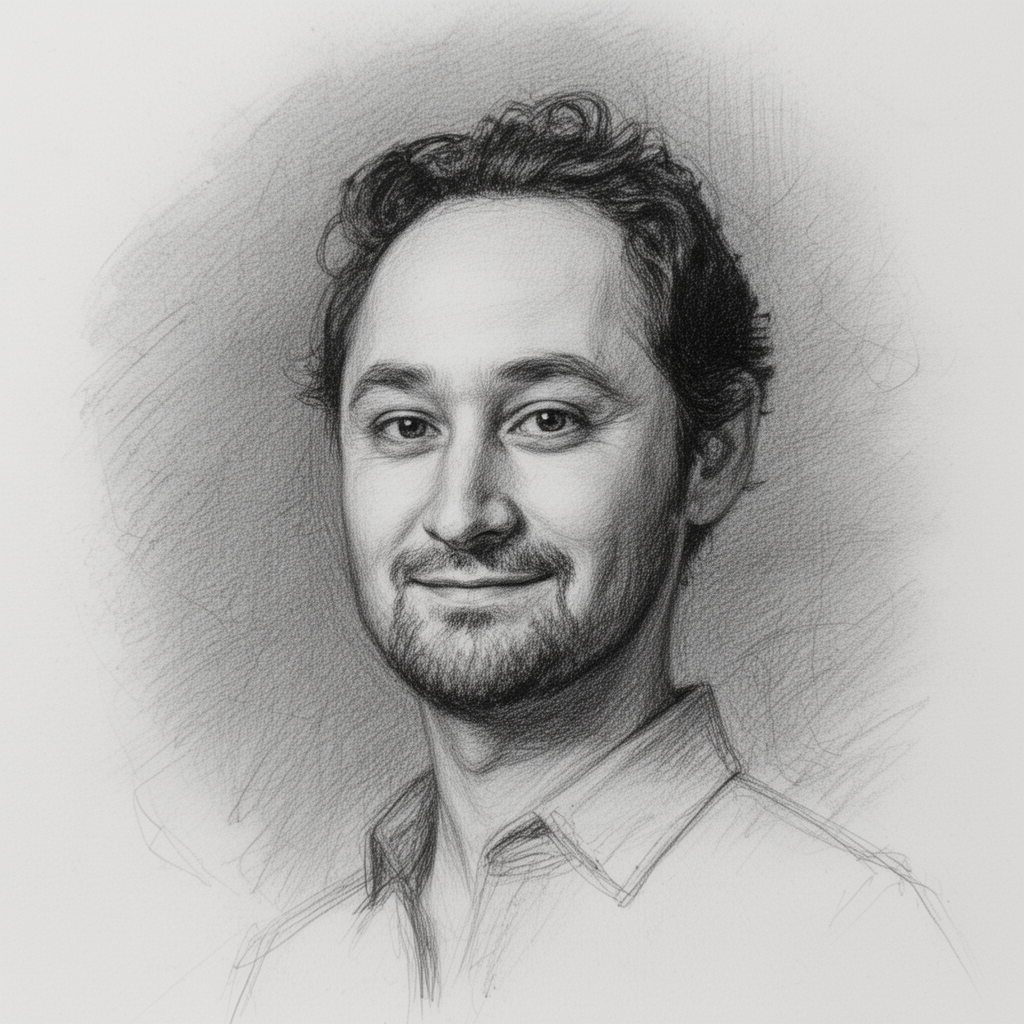
Who Is Jorge Colindres?
Jorge is Radical AI's cofounder. Before Radical, he was a venture capitalist. While reviewing pitch after pitch from AI startups, he grew frustrated. He watched companies build calendar optimizers and email copy generators while the technology capable of solving humanity's hardest problems went untapped. The moment of clarity came sitting next to his co-founder Joseph: "Why are we not solving cancer with machine learning?" That question became the company.
Jorge doesn't start with intuition. He starts with research — 200 papers worth — and then moves with the kind of conviction that only comes from having done the homework. His frustration wasn't performative. When he talks about the disconnect between ML's promise and what the industry was actually building, you can hear the real irritation. That frustration drove him down a rabbit hole of systematic investigation, and what he found confirmed what he suspected: the technology was powerful, but people were picking low-hanging fruit.
What sets Jorge apart is his willingness to question the entire operating model. Legacy materials companies have been around 100+ years and make billions. They're not incentivized to invent the future. So instead of selling designs to them, Radical AI is building a fully verticalized company. That's not an incremental improvement. That's a deliberate choice to rebuild the entire category from first principles — because Jorge saw the connection between domains that the established players keep separate.
He reads voraciously, writes code, and asks about microscopy analysis and quantum mechanical data. But understanding alone isn't enough — he has to construct the system that makes the vision real. That drive to systematize everything, to turn insight into infrastructure, is what took Radical from a conviction about how science should work to a company that's proving it.
The Story Behind Radical AI
It was 2022. Jorge was investing in deep tech and software at a VC firm, sitting next to his co-founder Joseph, also a VC with a deep tech focus. AI companies kept pitching them. Wave after wave of ideas. And Jorge felt something close to betrayal. Not anger — worse. Disappointment at the gap between what was possible and what was being built.
He decided to find out if he was wrong. Over the next year, he read 200+ machine learning research papers. Not abstracts. Papers. He wanted to understand the fundamental capability of the technology. And the conclusion was unavoidable: the technology was powerful. But the applications were safe, incremental, low-hanging fruit. The moment came when he turned to Joseph and said it out loud: "Why are we not solving cancer with machine learning?"
Joseph didn't say yes immediately. He said: "I don't know about cancer, but let's look into different spaces." They discovered their third co-founder, Herd Seder, a leading academic in machine learning applied to materials science. The three of them realized what they were building wasn't optional. "Science was moving in this direction. Whether we started a company or not, it was inevitable. We knew we had to give it a shot."
That was the turning point. But the real commitment came later. Jorge went from talking about the idea to walking away from venture capital. From having opinions about how the world should work to building proof that it could.
How Jorge Leads
Jorge is a consensus-builder, but not in a passive way. He builds consensus around a firm conviction. He's thought about the problem enough to have a position, but he's open about how he arrived there and why. When he narrates decisions, it's "we discovered" and "the team realized," but there's no ambiguity about who set the direction.
He leads through clarity. He can explain what Radical AI does to an elementary schooler, to investors, and to engineers, and the explanation changes form but not substance. That precision — the ability to distill a complex system into its essential components — is rare in technical founders. He talks about the ML pipeline, the robotic lab feedback loop, the data moat, and he makes each piece feel inevitable, not clever.
His decision-making is risky but not reckless. He talks about "making quicker decisions with less information" as a principle for operating when you're in genuinely new territory. But he also emphasizes long-term thinking over short-term wins. "If you have long-term vision but no intermediate progress, then it's a fantasy. And if you only have short-term results and no long-term vision, then what are you even doing?" He's thought about the paradox and resolved it: you need both, operating on different clocks.
The core tension: Impatience vs. Patience. Jorge is impatient about the big picture — science is too slow, he's going to fix it. But he's patient about the path, willing to go through all 95% of failures because each one is data. This tension lets him push for speed without breaking quality. It's what lets him hire people with no materials background and make it work.
What It's Like to Work with Jorge
Jorge doesn't lead through charisma. He leads through alignment. In conversation, he's measured, rarely animated except when describing the research rabbit hole or the torch test. He thinks out loud in complete thoughts, which means his answers are thorough but not spontaneous. He respects silence — when asked a hard question, he pauses and then commits to a real answer, not a prepared one.
He takes feedback literally. When Angelina sketched a naive version of how the system works — "I'm not a materials scientist, I'm just making things up" — he didn't correct the caricature. He used it as a framework for explaining how it actually works. That's generosity. It means when an engineer on his team proposes something, he's likely to engage with the spirit of the idea rather than dismissing rough first drafts.
What might surprise someone joining Radical: Jorge is not trying to convince you that you should be there. He's filtering for people who are already convinced the mission is worth the pain. "You are not here for a job, you are here for a mission." That's not inspirational fluff in his mouth. It's a statement of fact. If you're looking for flexibility, remote work, or a stepping stone, Radical isn't for you. If you're looking for the torch test moment — real evidence that what you're building works — he'll give you that.
Why This Matters (For You)
If You're in Materials Science or Advanced Manufacturing
Radical AI directly challenges the bottleneck you're living in: the 10-20 year cycle from material discovery to production. If you're an R&D director, materials scientist, or procurement decision-maker in aerospace, energy, or advanced manufacturing, the core insight is worth sitting with — traditional materials development publishes the 5% of iterations that work, but discards the 95% that failed. Radical AI captures that hidden data and feeds it back into ML systems that compress decades into months. The result isn't just faster discovery. It's access to materials compositions and performance characteristics that wouldn't have been found within your organization's timeline budget. If your company's roadmap depends on discovering or validating new materials faster, Radical's approach is directly relevant to your strategic options.
If You're an Engineer Building with AI Systems
Radical's approach is ruthlessly problem-first. Before you build a bigger model, before you optimize for speed, understand what you're trying to solve. Then build the minimal system that solves it. Radical didn't say "we need the best ML model." They said "we need to discover materials faster," which led to ML + robotics + the feedback loop. The moat isn't any single tool — it's the system that captures data nobody else can. Take that lesson: your competitive advantage is probably not in the architecture. It's in the data you can accumulate that others can't.
If You're Early in Your Career
Jorge's path is nonlinear: founding engineer → VC investor → founder. That jump looks risky, but it wasn't random. He spent a year learning the landscape, understanding what was possible, and then betting everything on a thesis. The lesson isn't "take big risks." It's "do the homework first, then commit fully." He read 200 papers. He didn't just have a hunch. And once he committed, he didn't hedge — 5 days a week in person, working through the pain because he'd already made the decision that the problem was worth it. Long-term thinking means accepting that the first 5 years will be hard, so you might as well go all-in.
If You're Considering Joining Radical AI
Radical selects for mission alignment over pedigree. 70-80% of the team doesn't come from materials science. They came because they believe the scientific method needs to be rebuilt. That means Radical is betting on your ability to think and iterate in genuinely novel territory, not your materials science credentials. You'll work in-person 5 days a week because that's the pace required to move fast on something this ambitious. And you'll have direct access to the lab, the torch tests, and the proof points — the moments that make the abstraction real. If you want to see the physical manifestation of the problem you're solving, Radical does that.
Join Radical AI
Now that you know how Jorge Colindres leads, see if there's a role for you.