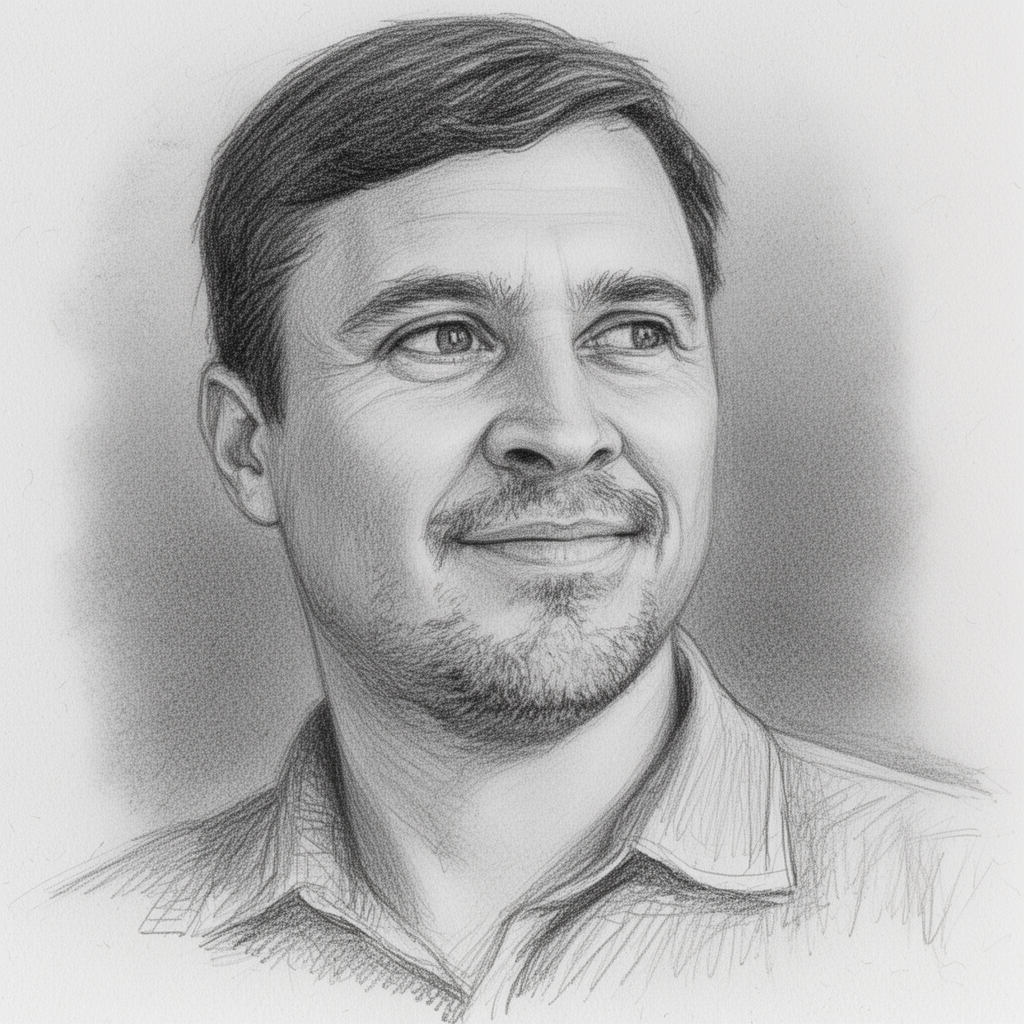
Who Is John Berryman?
John Berryman is the kind of engineer who leaves one of the most consequential AI products ever shipped because he needs to see the whole landscape, not just the view from one building. As an early engineer on GitHub Copilot, he helped build the foundation for AI-assisted code completion before most developers had ever heard the term. He co-authored the O'Reilly book Prompt Engineering for LLMs with one of Copilot's research co-founders. Then he walked away.
Not because something was wrong at GitHub. Because something was missing: breadth. John had spectacular fundamentals but had missed the explosion of tools, frameworks, and paradigms happening outside Copilot's walls. So in May 2024, he launched Arcturus Labs, an AI consulting practice where every engagement is a new domain -- therapist training simulations, model fine-tuning pipelines, RAG architecture redesigns -- and no two projects look alike.
What makes John distinctive is not the prediction (every AI person has predictions). It's the decomposition. Where others see black boxes, John sees pipelines with identifiable failure points. Where others reach for frameworks, John builds from first principles with whatever materials are available. And where others hedge their predictions, John delivers his with a deadpan "I think we're all doomed" that became the running joke of the entire conversation.
The Archetype: The Sage
The Sage
The Explorer
The Return
John's core drive is understanding. He doesn't just build systems -- he needs to understand why they work, how they break, and what they're actually made of before he touches them. When asked about RAG, his instinct wasn't to recommend a tool or framework. It was to decompose: "RAG is an agent and it's search. And that's all there is at this level. But let's peel back the onion a little bit further." Then he decomposed each of those into their sub-components, and each of those into theirs, until what started as a black box became a pipeline of individually debuggable pieces.
This Sage drive shows up everywhere in his career. The O'Reilly book. The blog posts that explore ideas like Roaming RAG (agents navigating collapsed tables of contents instead of querying vector databases). The consulting practice designed to maximize breadth of learning across domains. He accumulates knowledge and then transmits it -- through writing, through consulting, through teaching his own kids.
His secondary archetype is The Explorer. The restlessness that pulled him out of GitHub -- choosing the uncertainty and breadth of consulting over the comfort and depth of a corporate role -- is Explorer energy. "Every month or two is a completely new world. There's not one project I've done that has any similarity with any other project."
"I always work from first principles."
The Hero Match
Daedalus
In Greek mythology, Daedalus was the master craftsman who built the Labyrinth, fashioned wings from wax and feathers, and solved impossible engineering problems through first-principles thinking. He wasn't a warrior or a king. He was the person you called when you needed something that had never existed before, built from whatever materials were at hand.
John's approach to building AI systems mirrors Daedalus at every turn. His RAG philosophy -- build from scratch according to the user's actual information needs rather than reaching for off-the-shelf solutions -- is Daedalean. His Roaming RAG system bypasses the entire vector search infrastructure by having agents traverse a collapsed table of contents structure. That's building wings from feathers and wax while everyone else is trying to buy a plane ticket.
And like Daedalus, who had to escape the very Labyrinth he built, John left the system he helped create at GitHub. Staying inside meant losing sight of the broader landscape. The escape wasn't dramatic -- it was deliberate, principled, and driven by the realization that depth without breadth is its own kind of trap.
Doc Brown — Back to the Future (Part I: the garage-inventor version)
John has the same combination of deep technical understanding, playful dark humor, and slightly wild-eyed predictions about the future that defined Doc Brown before the time machine worked. Doc Brown built a time machine in a garage from a DeLorean; John builds RAG systems from collapsed tables of contents instead of vector databases. Both see futures that others can't, both deliver their predictions with self-aware humor, and both have a domestic life that keeps the genius grounded.
"I think we're all doomed. That's going to be the clip. That's going to be the starting clip. I just knew it is."
The Story Behind Arcturus Labs
The moment that explains John Berryman best didn't happen in a board room or at a product launch. It happened in the gap between GitHub and everything that came after.
For years, John had been inside one of the most important AI products in the world -- GitHub Copilot. He'd helped build it from scratch, at a time when nothing like it existed. The fundamentals he developed there were extraordinary. But fundamentals have a cost: while he was deep inside Copilot's architecture, the entire ecosystem was exploding around him. LangChain. New agent paradigms. Competing frameworks for understanding what these models could actually do. By the time he looked up, he'd missed an entire revolution happening just outside his window.
So he did something that most engineers in his position wouldn't. He left. Not for another prestigious role, not for venture funding, not for a co-founder with a pitch deck. He left to become a consultant -- a role with no guaranteed income, no team, and no certainty about what next month would look like. "There's sometimes where I'm so busy that it's annoying. And there's sometimes where I'm not busy and I get nervous."
He did it in part because he wanted his kids to watch. "I wanted them to see me visibly struggling and failing and being confused and getting up and trying again and succeeding." His eight-year-old son now has a website arcade with roughly a hundred games built using Cursor, published to GitHub Pages. His wife vibe-coded a Revolutionary War education game for their homeschool curriculum. The family fallback plan, if the dystopia side wins? His grandmother's farm in West Tennessee. "We're teaching them how to farm."
The Founder's Journey and The Company's Journey
Search engineer with deep fundamentals, built Copilot from scratch at GitHub, realized breadth was missing, left for consulting, faced the feast-or-famine reality honestly, now transmitting accumulated wisdom through writing, consulting, and teaching the next generation.
Arcturus Labs started as a solo consulting practice with spectacular AI fundamentals but zero marketing infrastructure. Each engagement is a completely new domain -- therapist training simulations, RAG architecture redesigns, model fine-tuning pipelines. The company is a vehicle for its founder's core drive: understanding how AI systems actually work across every possible application.
The Sage who needed to understand everything built a company designed to expose him to everything. Arcturus Labs isn't a product company or a platform -- it's a knowledge-accumulation engine that funds itself through the act of solving new problems. The company's journey IS the founder's learning journey, made tangible.
How John Leads
John owns his decisions and draws honest lines around what he knows and what he doesn't. When asked whether he'd hire an AI agent or a junior developer, he paused -- "I'm afraid I'm going to say" -- and then committed: the agent. He knew it was provocative. He said it anyway, then explained his reasoning clearly.
But he's equally direct about his limits. On marketing: "The hardest thing is something that I'm still not good at yet." On the future of specialist roles: "I haven't resolved that in my head." On how the internet will replace PageRank: "We'll solve it. I don't know how." Most founders either overclaim certainty or underclaim agency. John does neither.
His consulting style reflects this: he doesn't arrive with a pre-built solution and deploy it. He arrives, decomposes the problem into its pieces, figures out which piece is actually broken, and builds a fix from first principles. Every engagement starts from scratch because every domain is different.
Founder Superpowers
Decomposing complexity into debuggable pieces
When most people see a black box, John sees a pipeline with identifiable failure points. His RAG framework -- "RAG is an agent and it's search. And that's all there is" -- then agent into for loop + LLM + tools, search into query formation + result quality + relevance tuning. This decomposition instinct is what made him valuable at Copilot and what makes his consulting practice work across wildly different domains. He doesn't solve problems; he disassembles them until the broken piece is obvious.
Building from constraints, not from abundance
John's instinct is to build with fewer materials, not more. Roaming RAG bypasses vector databases entirely. His career choice to consult rather than raise funding means building from revenue, not venture capital. His description of AI as "just an HTTP request -- text comes in, text comes out" strips away mystification. Where others add infrastructure, John removes it until only the essential remains.
Translating between abstraction layers without losing fidelity
John moves from concrete implementation details (how semantic search maps "gorilla suit" to "monkey costume") to sweeping predictions (the end of websites as we know them) without dropping context. The technical understanding is what makes the predictions credible. Most people who do the detail well can't do the macro prediction, and vice versa. John does both and connects them.
What It's Like to Work with John
Working with John means working with someone who will take your problem apart before he tries to fix it. He won't arrive with a pre-built framework or a favorite tool. He'll arrive with questions: what's the actual information need? Where in the pipeline is it breaking? What's the simplest thing that could work?
He's deliberate in conversation -- he lets questions land, thinks before speaking, and builds arguments layer by layer. But when an idea excites him, the energy shifts. The section of our conversation about websites being replaced by llms.txt files and APIs had both of us building on each other's half-finished thoughts, neither wanting to stop.
His humor is dry, self-aware, and ever-present. Five or six "doomsday predictions" emerged during our conversation -- websites dying, PhDs becoming obsolete, junior developers casting spells they can't debug -- and each one was delivered with a deadpan warmth that made the dark content genuinely fun. "I think we're all doomed" became the running joke, and by the end, John was already predicting it would be the opening clip.
He's honest about what he doesn't know. That sounds simple, but in the AI space, where everyone performs certainty, it's distinctive. John will tell you exactly where his knowledge ends and his uncertainty begins -- and he'll do it without losing authority. "We'll solve it. I don't know how, but we'll solve it."
"AI is just an HTTP request. Text comes in, text comes out. It's kind of magic, whatever happens in the middle, but you don't have to worry about that."
Why This Matters (For You)
If You're Building AI Applications and Hitting a Wall
John's core insight is that most AI failures aren't AI problems -- they're pipeline problems disguised as AI problems. If your RAG system isn't working, it's not because "RAG is broken." It's because something specific in the pipeline is broken: the query formation, the result quality, the relevance tuning, or the agent's interpretation of the user's intent. His approach -- decompose, isolate, debug each piece independently -- is immediately applicable to anyone shipping AI in production. The question to take back to your own work: are you debugging a black box, or have you mapped the pipeline?
If You're an Engineer Rethinking Your AI Architecture
John's technical philosophy challenges the assumption that more infrastructure means better results. Roaming RAG works without a vector database. Lexical search handles arbitrary filters without slowing down when semantic search chokes on them. Fine-tuned small models can outperform expensive large models in tight domains. His framework for choosing between semantic and lexical search -- "If your problem needs to match on ideas, semantic. If you need exact match, lexical. And there's no reason you can't combine them" -- is the kind of decision tree that saves weeks of wasted architecture work. The question: what infrastructure are you maintaining that you could replace with a simpler approach?
If You're Early in Your Career
John's career arc is a case study in the long game. He spent years in search engineering before AI was a thing. He built Copilot from scratch. Then he left GitHub precisely because the depth was costing him breadth. His advice -- "abstract general thinking and entrepreneurship" -- isn't about picking the right technology to learn. It's about building the meta-skills that survive when technologies change. He's teaching his eight-year-old to build games with Cursor, not because Cursor will matter in ten years, but because the act of building matters. His career lesson: spectacular fundamentals plus willingness to start over beats specialized expertise every time.
If You're Considering Joining Arcturus Labs
John leads by decomposition, not by direction. He won't hand you a playbook -- he'll hand you a problem and expect you to break it into pieces, figure out which piece is broken, and build a fix from first principles. His consulting practice is designed so that no two engagements look alike, which means you'll be learning constantly but never coasting. He's honest about the hard parts (feast-or-famine consulting, marketing challenges, the fire hose of keeping up with AI) and he models the behavior he expects: visible struggle, visible learning, visible recovery. If you thrive on variety, first-principles thinking, and intellectual honesty, this is your kind of environment.
Read John's book
Prompt Engineering for LLMs — the practical book on building production-quality LLM applications, co-authored with O'Reilly.