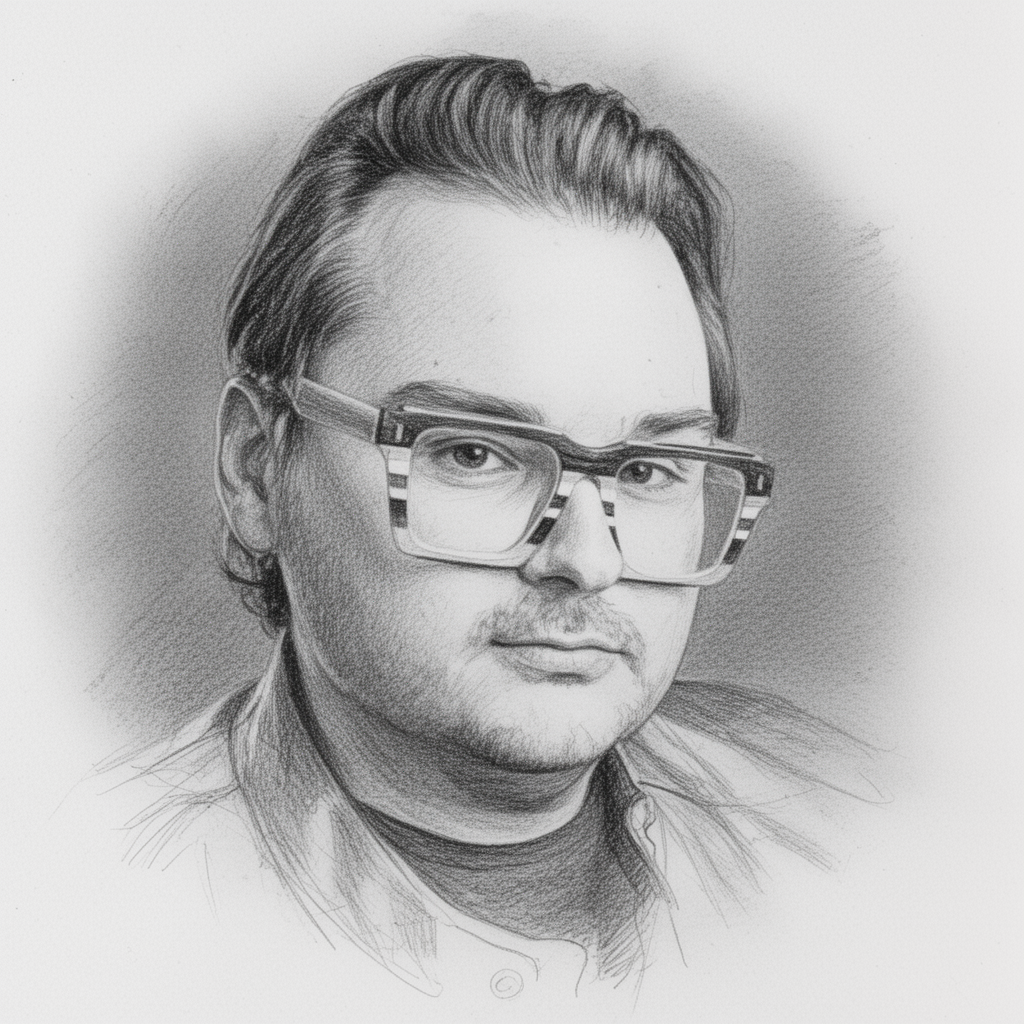
Who Is Daniel Davis?
Daniel Davis has lived several lives in tech, each one preparing him for the next. Radio host. Music manager. Inside the DOD's black programs, investigating how classified information gets distributed. Autonomous vehicle engineer at Lyft, learning how systems fail at scale. Open-source maintainer and architecture thinker at TrustGraph.
What connects these chapters isn't ambition — it's a single obsession: how do you know what's true? In a world where AI systems confidently serve wrong answers, where misinformation spreads faster than correction, where context gets stripped away, Daniel has built infrastructure designed to preserve truth. Not as a marketing angle. As an existential concern.
"It legitimately scares me," he said, talking about the convergence of blind information acceptance and consolidated power. That fear is the animating force behind TrustGraph.
The Archetype: The Sage
The Sage
The Rebel
Tests & Allies
Daniel is fundamentally a truth-seeker. He researches topics for decades not for career advancement but because the question compels him. He reads papers from DARPA's machine understanding conferences in the '90s. He studies DOD classification systems. He digs into Wikipedia's editorial process. He doesn't do this to build a startup — he does it because understanding how knowledge works is what he does. Understanding is the North Star.
The Sage's second drive is teaching. Daniel explains concepts through stories because abstraction without narrative doesn't stick. When explaining reification (statements about statements), instead of giving the paradigmatic definition, he pivots to his colleague Mark's cat: "Remember how I said Fred has four legs. Then I said Mark told me, and Mark told me on Friday. That's reification." The story rescues abstraction. Every interview answer arrives wrapped in narrative because that's how he thinks.
His secondary archetype is The Rebel — he's not just seeking truth; he's exposing the narratives that obscure it. "Almost all of them are faking it," he said about companies claiming to have context graph technology. He calls out Wikipedia's unreliability when everyone defaults to it. He challenges the scaling-law mythology in deep learning. He dismisses the hype cycle with the same matter-of-factness he'd use correcting a technical mistake. The Sage wants to understand; the Rebel wants to disrupt the comfortable lies.
"I'm really worried about some of this stuff," he said. "The thing that legitimately scares me is I don't hear people from the AI Frontier Labs talk about these topics — more about the ambiguity in meaning, in what is fact and fiction."
The Hero Match
Cassandra of Troy
Daniel is Cassandra — the figure cursed to see the truth and not be believed. He watched autonomous vehicle safety recommendations from RAND get ignored by the industry. He watched the AI industry refuse collaboration, build in silos, deploy without guardrails. He sees companies claiming context graph technology when he knows they have nothing real under the hood. He sees AI systems confidently serving wrong answers. And his response to each is genuine alarm that few are listening.
Three moments from the conversation capture this perfectly:
The 9-out-of-10-experts story — Daniel discovered something true about how military classification systems work, a fact grounded in an obscure DOD distribution statement. He asked experts, nine different people, and they were all wrong. The one person who knew was in "very niche things." Truth lived at the margin, not in the center where everyone assumed it would be.
"I'm flabbergasted myself when I asked some of these AI services simple questions and it just still gets it wrong." The genuine distress here isn't about product incompleteness — it's about an obvious problem the industry isn't addressing. He sees it clearly. Why doesn't everyone else?
"I see two things happening and they're kind of converging." Blind information acceptance, consolidated government power, the erosion of context in how people understand the world. He's seeing a trajectory. Few others are.
But Daniel differs from Cassandra in one crucial way: he's building. TrustGraph isn't just a warning; it's infrastructure designed to preserve truth. He's not resigned to being unheard; he's engineering the solution while sounding the alarm.
Fox Mulder — The X-Files (Seasons 1-5)
Daniel self-identified with this parallel. His colleagues in the DOD called him "Spooky" — Mulder's nickname. Like Mulder, Daniel spent a government career investigating anomalies that mainstream institutions dismissed. Like Mulder, he has a deep conviction that the truth is more complex than official narratives suggest. Like Mulder, he follows threads that others consider fringe — UAP research, classification system loopholes, semantic web papers from the 90s — and finds real signal in places the establishment ignores.
The match is specifically early Mulder, before the conspiracy mythology overwhelmed the character. That Mulder was a brilliant analyst who happened to care about questions no one else would touch, working within institutions while questioning them. That's Daniel: a government insider turned tech founder who challenges industry narratives while building infrastructure within the industry.
"The truth is out there." Mulder's catchphrase maps directly to Daniel's entire thesis: truth exists, but the systems we're building can't find it reliably. Both believe the infrastructure of truth-finding is broken and needs to be rebuilt from the foundation up.
The Story Behind TrustGraph
The Founder's Journey ↔ The Company's Journey
Investigated how systems fail (autonomous vehicles, government classification, AI confidence). Saw that context gets stripped away at every layer. Obsessed over graph structures and knowledge representation. Discovered that the existing solutions (vector databases, similarity search) were solving the wrong problem. Built TrustGraph.
A quiet open-source project that nobody cared about ("We called it trust rag for a while. Nobody cared"). Gained traction when people actually understood what it solved. 1.3K GitHub stars. 10x website traffic. Foundation Capital article. Bay Area speaking invitations. Now at the inflection point where the market is catching up to the problem.
The same archetype drives both: The Sage who sees what others miss. The Rebel who challenges comfortable assumptions. A person who works at the margins where the truth actually lives, gradually building enough credibility that the center has to listen.
How Daniel Leads
Daniel leads through conviction, not consensus. He takes strong positions on what's right — the architecture direction, which approaches are dead ends, what the industry is getting wrong. But his strength is that he backs those positions with reasoning you can follow, evidence you can examine, logic that compels even if it disagrees with you.
He's a teacher at heart. He checks comprehension mid-explanation: "Are you familiar with the promise of the semantic web?" He adjusts depth based on response. When Angelina presented a naive architecture (vector database + Neo4j + similarity search), he didn't dismiss it. He mapped it onto the correct framework and explained the fork in the road — here's where you end up if you build that, here's what you're missing, here's why you'd end up there anyway. This is rare. Most technical founders either talk over their audience or dumb it down. Daniel teaches at the listener's level while preserving full complexity.
His decision-making style is collaborative on execution and sole on vision. He narrates product decisions in first person: "I've taken the position that a context graph is simply a graph structure optimized for AI technologies." Then the co-founder Mark builds it. Vision is non-negotiable; the path to execute is collaborative. This works because the vision is grounded — it comes from obsessive research, not marketing intuition.
The core tension: Truth-Seeker vs. System-Builder — Daniel is torn between investigating what's broken (misinformation, hype cycles, expert fallibility) and building the infrastructure to fix it. The investigator wants to keep pulling threads: UAP research, Wikipedia manipulation, GPU market reality, AI confidence without competence. The builder needs to ship. The tension produces his energy: the alarm about truth decay fuels urgency to build, and the building keeps uncovering more reasons for alarm.
Founder Superpowers
Making the Abstract Tangible Through Story
Daniel never explains a concept without a concrete example. Reification becomes "Fred has four legs, Mark told me on Friday." Context graphs become the NHL coaches test. Trust becomes the DOD distribution statement story. Expert fallibility becomes nine-out-of-ten wrong. This isn't just communication skill — it's his primary thinking mode. He told Mark Adams' cat story, the Metallica top-10 list, the Wikipedia editors-for-hire exposé, and the Eisenhower appearance-vs-reality theme all in one hour-long interview. Every abstraction earns a story.
Reading the Room While Teaching It
Daniel is simultaneously a teacher and a calibrator. He checks comprehension mid-answer, adjusts depth based on response, and uses the listener's naive implementations as launching pads for explanation. When Angelina presented the wrong architecture (vector + Neo4j + similarity search), he didn't dismiss her. He mapped her proposal onto the correct framework and explained why the industry ends up there anyway. This is rare and difficult: most technical founders talk over the audience or talk down to it. Daniel teaches at your level while preserving the full complexity.
Pattern-Matching Across Decades and Domains
Daniel connects autonomous vehicle safety (2018) to AI deployment liability (2026). He connects 1990s DARPA MUC conferences to modern context graph retrieval. He connects DOD classification systems to information trust frameworks. He connects Eisenhower's appearance-vs-reality presidency to the truth decay problem in AI. This isn't random reference-dropping — it's genuine cross-domain pattern recognition from a career that touched government, entertainment, automotive, and tech. He sees structural parallels that specialists in any single domain would miss.
What It's Like to Work with Daniel
Working with Daniel means being in a room where precision matters and stories matter equally. He expects rigor — he's genuinely pedantic about terminology, will correct you mid-conversation, needs the logic to track. But he uses stories to keep abstraction from suffocating you. He's high-energy when explaining something he cares about, asks you questions to check understanding, and genuinely wants you to follow the reasoning, not just believe it.
He's comfortable with strong disagreement. He doesn't soften positions for social comfort. But that directness isn't hostile — it's the confidence of someone who's checked his work. "Almost all of them are faking it" isn't throwaway cynicism; it's the conclusion of someone who's actually verified which companies have real technology and which don't.
There's something unusual about his ambition structure. He doesn't optimize for growth, funding, or status. He optimizes for the idea being right. "We called it trust rag for a while. Nobody cared. You know, it is what it is." No desperation in that statement. Just "the market found us when the problem became obvious." He's visibly uncomfortable with hype and marketing angles. The company's success isn't the thing animating him; understanding is.
He credits people extensively — Mark Adams, Vicky Froyen, Kirk Marple. This isn't deflection. He owns his positions firmly. It's a signal of intellectual integrity: he tracks where his ideas came from and he's generous with attribution. If you work with Daniel, you're working in a system where getting the idea right matters more than getting the credit.
Why This Matters (For You)
If You're Building AI Agents That Need Context You Can Trust
Daniel's core insight is this: without context, AI systems are confident hallucinations. A language model can predict the next token beautifully, but it has no way to know if that prediction is true. Add context — real information, not similarity scores from embeddings — and the system has a fighting chance to ground its answers in reality instead of plausibility.
If you're building agents that need to make decisions, retrieve reliable information, or avoid confidently serving wrong answers, TrustGraph solves a structural problem you're probably hitting right now. The question Daniel kept returning to: what infrastructure lets agents distinguish between plausible and true? That's what context graphs do.
If You're an Engineer Building Context Infrastructure
Daniel's technical decisions come from decades of thinking about knowledge systems. He's chosen a graph-based architecture over vector embeddings. He's betting on RDF 1.2, not custom ontologies. He's building for extensibility over premature optimization. These choices matter.
The deeper lesson is how he thinks: he looks at what industry is doing (similarity search, semantic matching) and asks whether that's actually solving the right problem. Usually, it's not. Usually, the right problem is at a different level of abstraction. The industry builds convenience layers on top of architectural mistakes. Daniel builds the foundation.
If you're designing systems for information retrieval, context preservation, or knowledge representation, ask yourself: what's the right abstraction layer? What are we choosing not to solve? What seems to work because we've papered over the real problem? That's the Daniel Davis way.
If You're Early in Your Career
Daniel's path is unusual enough to be instructive: radio host, music manager, DOD programs, autonomous vehicles, open source, founder. Each step didn't look like career progression in real time. But what Daniel was actually doing was building understanding across domains. He was learning how systems fail. He was investigating questions nobody else was touching. He was patient.
When the right problem arrived, he recognized it because he'd spent years thinking about adjacent problems. The lesson: invest early in understanding how things work. Study failures, not just successes. Follow threads that interest you even if they don't have immediate payoff. The specificity of your knowledge matters more than the linearity of your path.
If You're Considering Joining TrustGraph
Daniel leads through conviction and teaching, not through consensus-building or social comfort. If you work there, you're in a system where the idea has to be right, where technical reasoning matters, where your ability to follow complex logic will be valued. You're also in a system where the founder is genuinely uncomfortable with hype, where the work is motivated by solving a real problem (not capturing a market), and where credit flows toward whoever got the idea right, not necessarily toward whoever had it first.
The question isn't "Will this make me rich?" or "Is this company cool?" The question is: "Do I care about information integrity in AI systems enough to spend years building the infrastructure that makes it possible?" If yes, you'd probably work well there.
Join TrustGraph
Now that you know how Daniel Davis leads, see if there's a role for you.