How Schema Markup Might Actually Work in AI Search
Angelina Yang, Founder & Host at TwoSetAI
Last updated: 2026-10-13. Originally published on Medium, December 17, 2025. Lightly adapted for twosetai.com with current cross-links to our pillar articles.
TL;DR
- Schema reinforces, it does not replace. Experiments show schema-only pages are completely ignored by ChatGPT, Gemini, Claude, and Perplexity [4][5].
- It works best alongside visible content. In a controlled test, identical pages with schema plus matching visible content led to about 30 percent more complete extraction than the same pages without schema [6].
- Microsoft has confirmed schema helps. Krishna Madhavan, Principal Product Manager at Microsoft, wrote in October 2025 that “schema is a type of code that helps search engines and AI systems understand your content” [1].
- The mechanism, inferred. Schema’s value likely sits in parsing (step 2) and chunking (step 3) of the retrieval pipeline, not in embeddings. It works like an attention mechanism: it does not add new information, it helps AI notice which visible content is structured and worth extracting.
- What to do. Put important information in your visible HTML first. Use schema to reinforce structured attributes (ratings, reviews, certifications, pricing). Use
@graphwith@idto connect related entities.
Microsoft confirmed schema helps AI systems understand content. But the mechanism? That is where things get interesting.
When you ask ChatGPT or Perplexity to search the web, it is not reading your schema markup the way Google reads it for rich snippets. Most people in SEO know that part intuitively. The conversation usually stops there, replaced by vague claims that schema “helps AI understand your content.”
Microsoft, creator of Bing and a key data source for ChatGPT, confirmed this in October 2025 [1]. That is useful confirmation. It does not tell us when schema actually matters, or how it gets used. That is what I want to dig into here.
Discovery vs retrieval: where does schema fit?
If you have read Ida Silfverskiöld’s breakdown of AI chatbot architecture, you know she splits the process into two phases: discovery and retrieval [2].
Discovery is finding candidate URLs. This is where traditional search engines like Bing still do the heavy lifting. They narrow the entire web down to a manageable set of pages worth looking at.
Retrieval is what happens next. The system fetches those pages, breaks them into chunks, and figures out which pieces actually answer the user’s question.
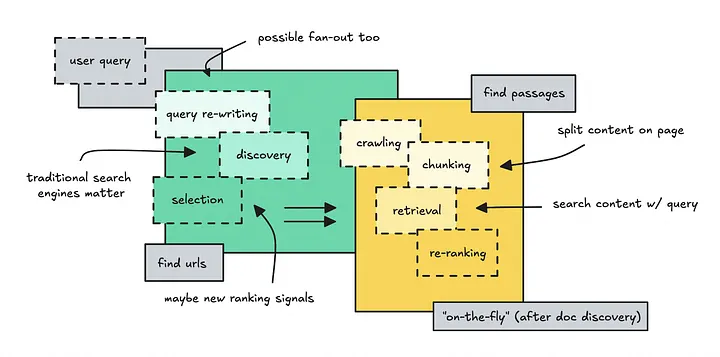 Discovery shown in green, retrieval in yellow. “Where does schema fit?” Adapted from Silfverskiöld [2].
For discovery, schema probably does not change much. That phase still relies on traditional SEO signals: authority, backlinks, crawlability. Schema helps you earn rich results in traditional search, but that is not new or AI-specific.
Retrieval is where things get interesting. Most people do not know this, but it is not one step. It is a sequence: crawl the page, parse, and chunk the content, then search those chunks for the best answer. Schema markup could potentially help at different points in this sequence. For a deeper mechanical walkthrough of the four stages, see The Difference Between Being Indexed and Being Cited by AI.
From keywords to entities: why structure matters now
Traditional SEO cares a lot about matching exact phrases. If someone searched “best running shoes for bad knees,” you would optimize for that exact string in your title, headers, and body copy.
That is changing. AI systems now think in terms of entities and relationships. A messy human question like “what should I get for my dad who runs but has knee problems” gets understood as structure: there is a person (runner with knee issues), a product need (footwear with cushioning and support), and a context (gift-giving).
The AI understands: who (a runner with knee problems), what (shoes with specific support features), and why (a gift). That is entities and relationships, not keyword matching.
Schema markup speaks this language natively. A Product schema declares:
- Here is an entity (the product)
- Here are its attributes (price, availability, rating)
- And here is how it relates to other things (brand, seller, reviews)
These are grounded relationships and concepts, not just keywords floating in prose. Think of it like the difference between reading a book with no chapter titles versus one with a detailed table of contents. Both contain the same information. One is much faster to navigate. The entity-side of the shift is also why hub-and-spoke internal linking matters so much, as I argued in The 5-Category Architecture.
Does schema get flattened into tokens like visible content?
Here is a question worth asking: what if AI systems just treat schema like any other text on the page?
In standard RAG (Retrieval Augmented Generation) pipelines, content gets flattened into text, then embedded as vectors for semantic search. If schema gets the same treatment, your Product schema becomes something like:
name ProBook 15 price 1299 offers priceCurrency USD availability InStock
If that is what happens, schema provides almost no incremental value. The visible text on your page already says “The ProBook 15 costs $1,299.” Flattening the schema just creates a near-duplicate.
There is evidence this is not how it works.
Julio C. Guevara’s 2025 tests created two product pages for fictional products. One had visible HTML plus schema. The other had schema only, with no visible text. When researchers asked ChatGPT and Gemini extraction questions (price, SKU, colors), the LLMs could only retrieve information from the page with visible text. The schema-only page failed completely [4].
SearchVIU ran an even more rigorous version in late 2025, testing eight different scenarios across five AI systems (ChatGPT, Claude, Gemini, Perplexity, and Google AI Mode). In one of their tests, they placed a product price exclusively in JSON-LD schema, not visible anywhere on the page. The result: zero out of five systems extracted it. Not one. They also tested hidden Microdata and hidden RDFa with the same result [5].
My read: schema probably is not flattened and tokenized alongside visible content. If it were, the schema-only experiments would have worked.
If schema is processed differently, when does that happen?
Let’s think through the retrieval sequence:
- Crawl — fetch the HTML
- Parse — extract and understand the content structure
- Chunk — break content into smaller pieces
- Embed and match — semantic search to find relevant chunks
- Re-rank — refine the results
- Synthesize — generate the final answer
If schema is not being tokenized like visible content, it is probably being leveraged earlier in this sequence: likely in parsing and chunking steps, before embedding happens.
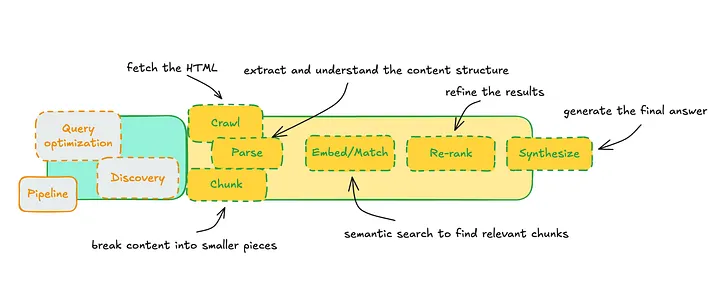 Retrieval pipeline in yellow with its six steps. Schema most likely acts at parse and chunk, before anything hits the embedding stage.
Parsing (step 2)
Schema could help the system decide what to do with a page right after fetching it.
Filtering. The system might use schema types to narrow candidates before semantic matching. A product query might prioritize pages with Product schema. A “how to” query might favor pages with HowTo schema. This happens upstream of embedding; the system is deciding which content is worth processing further.
Direct extraction. For certain factual queries, the system might bypass semantic search entirely and pull from structured fields. “What’s the price of the iPhone 16 Pro?” may not need embedding similarity. It needs a simple lookup: find Product schema, return the price field. If this is happening, schema lets the system jump straight from parsing (step 2) to synthesis (step 6).
Entity and relationship mapping. Schema with @graph and @id patterns pre-declares how entities on a page connect to each other. Without schema, the system has to infer: “This FAQ section is probably about the product mentioned above, which is probably sold by the company whose name is in the header.” That is a lot of guessing. With schema, the relationships are explicit: the FAQ is about the product, which is provided by the organization. Schema potentially hands over a mini knowledge graph instead of forcing the system to interpret the relationship from visible content. The entity-and-relationship signal is also central to what AI engines “hear” from a founder’s spoken content, which I unpack in What AI Engines Hear When a Founder Speaks.
Chunking guidance (step 3)
Schema could also inform how visible content gets divided into pieces. Microsoft’s October 2025 guidance describes how AI systems process content:
“AI assistants don’t read a page top to bottom like a person would. They break content into smaller, usable pieces, a process called parsing. These modular pieces are what get ranked and assembled into answers.” [1]
The key insight: AI does not read linearly. It chunks. And schema can guide that chunking process. If FAQPage schema exists, the system knows to treat each Q&A pair as a discrete unit rather than splitting a question from its answer. If Product schema exists, it knows product attributes should stay together rather than being scattered across chunks.
Better chunking leads to better matching downstream. Schema provides structural hints that help the system chunk intelligently. This is a standard RAG pattern. Dell Technologies describes “schema-aware chunking” that “recognizes that structured data’s meaning comes from its relationships and patterns” and “preserves schema information as metadata with each chunk” [9]. Stack Overflow’s own RAG implementation uses the same principle: “We configured our embedding pipeline to consider questions, answers, and comments as discrete semantic chunks” [10]. The same chunking logic drives what engines extract from a long video transcript, which I cover in How AI Engines Parse Video.
Embed/match and re-rank (steps 4 and 5)
After chunking, the system needs to find chunks that best answer the query. This typically involves embedding both query and chunks into vector space, then finding the closest matches. Some RAG systems preserve JSON structure and query it directly using something like JSONPath: “find the object where @type equals Product, return the price field.” If AI search platforms do this, schema would be extremely valuable: it lets the system extract precise facts without relying on semantic similarity.
Based on the experiments and standard RAG practices, we can reasonably infer that schema’s value is concentrated in steps 2 and 3 (parsing and chunking).
Evidence from a controlled experiment
So far, this has been theory. Here is where it gets interesting: there is evidence schema helps AI systems extract more from your visible content.
AISO ran a controlled experiment in early 2025. They created two identical websites about a fictional company called TechFlow Solutions. Same content. Same design. Same visible information, including product ratings like “4.8/5 stars (2,100+ reviews)” displayed on the page. The only difference: one site had comprehensive schema markup, one did not [6].
When asked about product pricing:
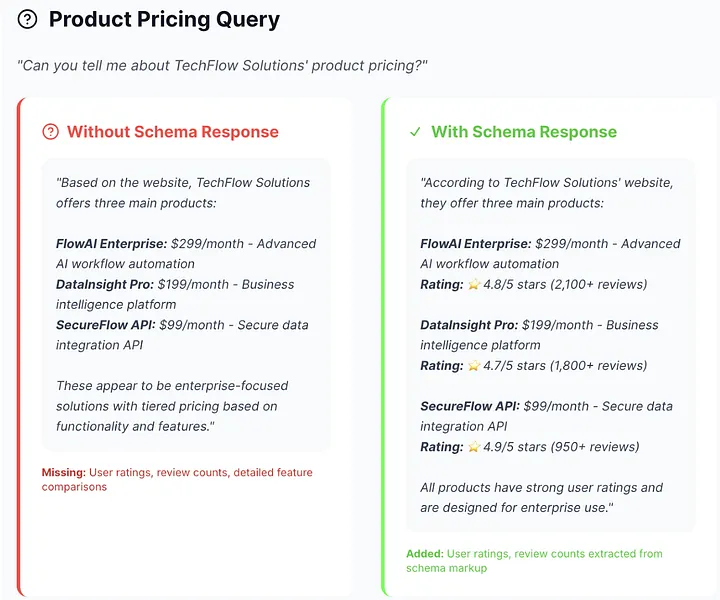 Side-by-side ChatGPT responses to the same product pricing query, with and without schema markup on the TechFlow Solutions page. Image via AISO’s controlled experiment [6].
- Without schema: ChatGPT returned basic pricing info: product names and monthly costs. It missed the ratings entirely, even though they were visible on the page.
- With schema: ChatGPT returned the same pricing plus user ratings (4.8/5 stars from 2,100+ reviews) and review counts.
The ratings were visible on both pages. The schema version did not have hidden data the other lacked. What changed was whether ChatGPT noticed that information and included it in the response. Similar patterns appeared across other queries. Overall, AISO scored the schema responses 30 percent higher on accuracy and completeness.
This suggests schema could work like an attention mechanism. It does not provide new information to the AI, but it helps the AI recognize which pieces of visible content are structured, important, and worth extracting. Think of it like highlighting. Both pages have the same text. The schema version has certain information structurally emphasized in a way the AI can recognize. The visible content and schema markup reinforce each other.
By passing specific URLs to ChatGPT, the experiment effectively intercepted the pipeline after discovery. ChatGPT was not choosing which pages to look at, so the test isolates the retrieval steps: crawling, parsing/chunking, and response synthesis. And on that question, the evidence suggests schema affects what gets noticed and extracted, even when the underlying content is identical. This connects directly to How AI Engines Decide What to Cite: per-engine citation choice depends on what the engine notices during extraction.
What we know vs what we are inferring
Let me lay out confidence levels.
Confirmed:
- Microsoft says schema helps their LLMs understand content [1]
- Fabrice Canel (Microsoft/Bing) has said schema helps AI-driven search since at least 2023, reaffirmed in March 2025 [7]
- Google says structured data provides “explicit clues about the meaning of a page” [8]
Supported by multiple experiments (limited scale):
- Schema-only content failed extraction in tests by Guevara (2025) and SearchVIU (2025) [4][5]. This suggests schema is likely not tokenized like visible content.
- Schema plus matching visible content appears to improve extraction compared to visible content alone (AISO experiment) [6].
Likely (strong inference):
- Schema is probably processed during parsing, not flattened into embeddings. It potentially enables filtering, direct extraction, and chunking guidance.
- Schema could work as an attention mechanism during parsing. It helps AI systems notice and prioritize structured information in visible content.
- The value is in recognition, extraction, and structured understanding, not as a standalone data source.
Unknown:
- Exactly how ChatGPT, Perplexity, or Gemini process schema internally
- Whether different schema types have different impacts
- Whether
@graphrelationships are processed differently than disconnected schema blocks - The exact mechanism by which schema improves extraction rates
What to do with this
Given the uncertainty, here is what makes sense:
Do not rely on schema alone. The experiments are clear: schema-only content fails. Schema cannot be your sole source. Everything important needs to be in your visible HTML.
Use schema to reinforce your most important information. The AISO experiment showed schema helps AI systems notice visible content. If you want ratings, certifications, or product details to surface in AI responses, make sure they exist in both visible content AND schema markup. The double-confirmation seems to help.
Focus on schema types with structured attributes. Ratings, reviews, certifications, pricing: these are the types that showed the clearest benefits in testing. Schema that merely duplicates prose (“description”: “We are a great company…”) probably adds less value.
Use @graph with @id relationships. Connect your entities explicitly. If the system does any kind of relationship mapping, explicit connections should help.
Implement schema for the confirmed benefits. Rich results still matter for traditional search. And the parsing/attention benefits in AI search are now supported by real experiments, not just theory.
The honest position
We are recommending schema because Microsoft confirmed it helps with understanding, because the architecture suggests it helps with parsing, and because empirical experiments show it affects what gets extracted. Based on our research, schema appears to work as a highlighting mechanism for AI systems. It helps them recognize and extract structured information from your visible content. It is not a ranking signal. It is not a secret data source. It is a way to make your content more machine-legible.
That is a narrower claim than most GEO vendors are making, and I think the narrower claim is the honest one.
Who is TwoSetAI?
TwoSetAI is one of the top AI podcast and video studios in Silicon Valley, and the team behind this article, hosted by Angelina Yang. The show has featured 100+ AI founders and leaders on how real AI products get built, sold, and trusted. Alongside the podcast, TwoSetAI runs the Founder Visibility Program that turns each conversation into the articles, clips, and pages that make its guests easy to find. Watch full episodes on YouTube at youtube.com/@TwoSetAI, and find every guest and episode at twosetai.com.
Glossary
- Schema markup (also called: structured data, JSON-LD, semantic markup). Machine-readable code added to a web page that describes entities, their attributes, and their relationships in a form search engines and AI systems can parse.
- Discovery vs retrieval (also called: candidate selection vs chunk extraction). Discovery is finding candidate URLs through traditional search engine indexes. Retrieval is fetching those pages, chunking them, and extracting the pieces that answer a user’s question.
- RAG (also called: Retrieval Augmented Generation, grounded generation). A pattern where an AI system retrieves documents or chunks relevant to a query, then uses them as context when generating an answer.
- Attention mechanism (as metaphor) (also called: highlighting, structural emphasis). The idea that schema does not supply new information but helps AI recognize which pieces of visible content are structured and worth extracting.
- Schema-aware chunking (also called: structure-preserving chunking, metadata-guided chunking). A RAG pattern where schema or document structure informs how content is divided into chunks, so related attributes stay together.
- Citable Surface (also called: retrievable attribute, extraction target). Any piece of a page’s structured or visible content that an AI engine can retrieve and quote. Coined by TwoSetAI; see the Video Content Advantage pillar.
About Angelina Yang
Angelina Yang is VP of AI, a fast.ai fellow, and the host of the TwoSetAI podcast, where she has interviewed 100+ AI founders and leaders about how real AI products get built, sold, and trusted. Find her on LinkedIn, talk to her AI clone on Delphi, watch the podcast on YouTube, or browse twosetai.com.
Frequently Asked Questions
Does schema markup help my content appear in ChatGPT and other AI search engines? Yes, but probably not as a direct ranking signal. Based on experiments and Microsoft’s confirmation, schema appears to help during the parsing and chunking phases of AI retrieval, helping AI systems notice and extract structured information from your visible content [1][6].
Can I put important information only in my schema markup? No. Multiple experiments show that schema-only content fails extraction across all major AI platforms (ChatGPT, Claude, Gemini, Perplexity, Google AI Mode) [4][5]. Everything important should appear in your visible HTML first. Schema reinforces visible content; it does not replace it.
What types of schema are most effective for AI search? Schema types with structured attributes show the clearest benefits: ratings, reviews, certifications, and pricing [6]. Schema that merely duplicates prose (like generic descriptions) probably adds less value. Focus on attributes that provide discrete, extractable facts.
Does schema help with discovery or retrieval in AI search? Primarily retrieval. Discovery (finding candidate URLs) still relies on traditional search engine indexes like Google and Bing. Schema’s value appears to be in the retrieval phase, most likely during parsing and chunking, helping AI systems process and extract from your content more effectively [2].
How is schema different from regular page content for AI systems? Experiments suggest schema is not embedded as retrievable content like visible text [4][5]. Instead, it likely functions as metadata that guides parsing, filtering, and chunking decisions. Think of it as structural hints that help AI systems navigate your content, similar to a table of contents.
Should I use @graph and @id in my schema markup?
If you have multiple related entities on a page, yes. @graph with @id relationships explicitly connects entities (for example, a product, its reviews, and the organization selling it). This could help AI systems understand relationships without having to infer them from text.
Does Stockebrand’s O’Reilly AEO book agree with this? Broadly yes, and at a less granular level. Rodrigo Stockebrand’s July 2026 O’Reilly book features Mark Williams-Cook’s DUCKYEA experiment and concludes schema gets “peeled out of the page and injected into the model’s context as text, with no special structural treatment” while still helping with entity disambiguation and knowledge-graph signals [11]. That is a subset of this article’s position; this article goes further by locating the mechanism in parsing (step 2) and chunking (step 3) and separating confidence levels.
References
[1] Madhavan, K. (2025). “Optimizing Your Content for Inclusion in AI Search Answers.” Microsoft Advertising Blog, October 2025. https://about.ads.microsoft.com/en/blog/post/october-2025/optimizing-your-content-for-inclusion-in-ai-search-answers
[2] Silfverskiöld, I. (2025). “The Architecture Behind Web Search in AI Chatbots.” Towards Data Science, December 2025. https://towardsdatascience.com/the-architecture-behind-web-search-in-ai-chatbots-2/
[3] Marvin, G. (2025). LinkedIn comment on AI Max attribution, December 2025. Referenced in PPC Land coverage.
[4] Guevara, J. C. (2025). Schema-only extraction tests, 2025. Referenced in Search Engine Roundtable and generative-engine.org. See also LinkedIn posts by Mark Williams-Cook and Julio C. Guevara.
[5] SearchVIU (2025). “Schema Markup and AI in 2025: What ChatGPT, Claude, Perplexity & Gemini Really See.” December 2025. https://www.searchviu.com/en/schema-markup-and-ai-in-2025-what-chatgpt-claude-perplexity-gemini-really-see/
[6] AISO (2025). “Schema Markup vs No Schema: A Real ChatGPT Experiment Reveals Surprising Results.” January 2025. https://www.getaiso.com/blog/schema_markup_experiment_blog_post
[7] Canel, F. (2025). SMX Munich presentation, March 2025. Referenced in Schema App coverage.
[8] Google Search Central. “Structured Data Documentation.” https://developers.google.com/search/docs/appearance/structured-data/intro-structured-data
[9] Dell Technologies. “Chunk Twice, Retrieve Once: RAG Chunking Strategies Optimized for Different Content Types.” Dell Technologies Info Hub. https://infohub.delltechnologies.com/en-us/p/chunk-twice-retrieve-once-rag-chunking-strategies-optimized-for-different-content-types/
[10] Stack Overflow (2024). “Breaking up is hard to do: Chunking in RAG applications.” Stack Overflow Blog, December 2024. https://stackoverflow.blog/2024/12/27/breaking-up-is-hard-to-do-chunking-in-rag-applications/
[11] Stockebrand, R. (2026). Answer Engine Optimization. O’Reilly Media, July 2026 (Ch 3, Williams-Cook DUCKYEA experiment and the schema-as-text framing). https://learning.oreilly.com/library/view/answer-engine-optimization/0642572275549/
Methodology note. Last verified 2026-10-13. Originally published on Medium December 17, 2025; the mechanism arguments and the confidence rubric are unchanged. Hyperlinks and cross-references to the TwoSetAI pillar series were added for this edition. Twosetai.com is the canonical home for this piece; the Medium version remains live. Krishna Madhavan’s October 2025 Microsoft Advertising post is the main primary source; the Guevara, SearchVIU, and AISO experiments are small-sample practitioner tests, so treat the specific numbers as directional. The “attention mechanism” metaphor is my framing, not a claim about how any specific engine implements it internally. The retrieval-pipeline step numbers (crawl, parse, chunk, embed, re-rank, synthesize) follow Silfverskiöld’s description. Stockebrand’s O’Reilly book was published seven months after this article’s original Medium publication; the comparison in the FAQ is my own.
Related Insights
Do You Actually Need a Knowledge Graph for Your RAG System?
Ofer Mendelevitch, Author, Independent AI Advisor at O'Reilly — Hands-On RAG for Production
How to Evaluate a RAG System Without a Golden Answer Set
Ofer Mendelevitch, Author, Independent AI Advisor at O'Reilly — Hands-On RAG for Production
How ClickUp Uses Merkle Trees to Build AI Agent Memory
Jay Hack, Head of AI at ClickUp